
Guaranteed payments, dated in advance.
A structured settlement turns a lump sum into a contractual schedule of payments from an A-rated life insurer—approved by a court, fixed in amount, and insulated from the market.
20+ years in Deerfield Beach · Licensed Florida professionals · Hosts of Money Talks on the Blue Couch

Guaranteed payments, dated in advance.
A structured settlement turns a lump sum into a contractual schedule of payments from an A-rated life insurer—approved by a court, fixed in amount, and insulated from the market.
20+ years in Deerfield Beach · Licensed Florida professionals · Hosts of Money Talks on the Blue Couch
Structured settlements, explained
Safe growth you can read on one page
Many settlements from personal-injury and similar cases are paid out over time by a life insurance company. When the original recipient prefers a lump sum, a court-approved transfer lets a conservative investor step into that payment schedule—at a discount that produces a guaranteed yield.

Backed by highly rated insurers
The payments are an obligation of the life insurance company that issued the original settlement annuity—typically rated A to A++ by AM Best, S&P, Moody’s or Fitch. You are relying on a contractual promise from a heavily regulated insurer, not on market performance.
Protected by court orders
Every transfer must be reviewed and approved by a judge under the Structured Settlement Protection Act—including in Florida. That judicial oversight confirms the seller understood the sale and that your right to the payments is clear.


No market risk, no ongoing fees
Your principal and payments are not affected by interest-rate moves, inflation surprises or Wall Street volatility. There are no annual fees, no commissions paid by you and no advisory costs once the purchase is in place.
Our structured settlements are
Built to Pay
Turn money you will not need for a few years into a dated schedule of guaranteed payments.
Meet the
Structured Settlement
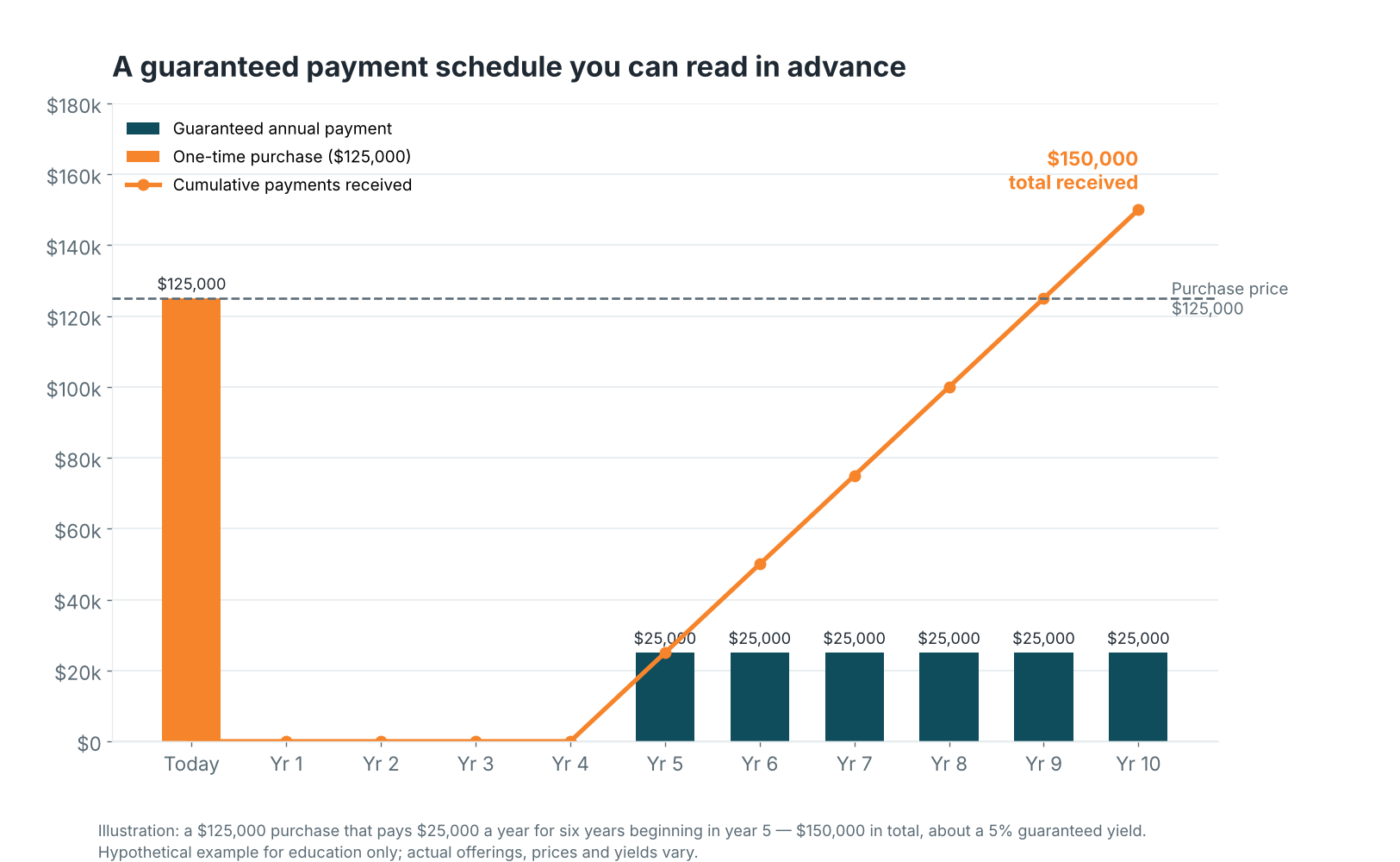
You purchase a schedule of future payments at a price that fixes your yield—typically 4% to 6% a year. Before you commit you see the purchase price, every payment date and amount, the total you will receive, the effective yield and the insurer’s rating.
Court approved
You know every payment before you buy
- A dated schedule from a highly rated life insurer
- Yield fixed at purchase—typically 4% to 6%
- Often tax-free or tax-deferred
Structured settlement payment rights are purchased in the secondary market through court-approved transfers under state Structured Settlement Protection Acts. Payments are fixed, not inflation-adjusted, and cannot be accelerated or easily resold; guarantees rest on the claims-paying ability of the issuing insurer. Not FDIC insured, not a security, not legal or tax advice. Illustrations are hypothetical and for education only.
Side by side
How structured settlements compare
Guaranteed, fixed and insulated from the market—in exchange for giving up liquidity.
Structured settlement
Bank CD
Bonds
Stocks
Rate of return
Fixed by contract—you know the yield before you buy
Fixed, but resets at maturity
Fluctuates with interest rates
Unknown
Market risk
None—payments do not change with markets
None
Yes—prices fall when rates rise
Yes
Income tax
Often tax-free or tax-deferred, depending on the settlement
Taxed every year
Taxed every year
Taxed on dividends and gains
Liquidity
Limited—for money you do not need to touch
Early-withdrawal penalty
Can be sold, at the market price
Can be sold, at the market price
Suited for income planning
Yes—a dated schedule of payments
Short-term savings only
Partly
No
Rate of return
Structured settlement
Fixed by contract—you know the yield before you buy
Bank CD
Fixed, but resets at maturity
Bonds
Fluctuates with interest rates
Stocks
Unknown
Market risk
Structured settlement
None—payments do not change with markets
Bank CD
None
Bonds
Yes—prices fall when rates rise
Stocks
Yes
Income tax
Structured settlement
Often tax-free or tax-deferred, depending on the settlement
Bank CD
Taxed every year
Bonds
Taxed every year
Stocks
Taxed on dividends and gains
Liquidity
Structured settlement
Limited—for money you do not need to touch
Bank CD
Early-withdrawal penalty
Bonds
Can be sold, at the market price
Stocks
Can be sold, at the market price
Suited for income planning
Structured settlement
Yes—a dated schedule of payments
Bank CD
Short-term savings only
Bonds
Partly
Stocks
No
Structured settlement payment rights are purchased in the secondary market through court-approved transfers under state Structured Settlement Protection Acts. Payments are fixed, not inflation-adjusted, and cannot be accelerated or easily resold; guarantees rest on the claims-paying ability of the issuing insurer. Not FDIC insured, not a security, not legal or tax advice. Illustrations are hypothetical and for education only.
Structured settlements are
Simple by Design
Contractual payments
The dollar amount, frequency and end date are written in the contract and cannot be cancelled.
Court-approved transfer
A judge reviews every transfer under the Structured Settlement Protection Act.
Yield fixed at purchase
The price you pay sets your return—recent offerings have generally run 4% to 6%.
Full transparency
Purchase price, payment schedule, total return, effective yield and insurer rating—all in writing.
4–6%
typical guaranteed yield on recent structured settlement offerings
Compare that with money sitting in a low-interest CD, savings account or conservative fund. If you have $50,000 to $500,000 you will not need for several years, a structured settlement can provide a higher, contractually guaranteed return—with your principal returned through the payment schedule.
Yields vary by offering, insurer and payment schedule; the range reflects offerings our partners have reviewed recently and is not a guarantee of future availability.
Before you invest
What to know—in plain English
We would rather you hear the trade-offs from us than discover them later.
Illiquid by design
Payments arrive on the schedule and cannot be accelerated. Reselling is possible but difficult. Only commit money you will not need in the meantime.
Fixed, not inflation-adjusted
Most schedules pay fixed dollar amounts. We pair them with inflation-aware income sources, such as Social Security and increasing-income annuities.
Due diligence matters
Work only with licensed professionals and reputable firms. We verify the insurer’s rating, the court order and who sends the payments before anything is signed.
Getting started is
Easy to Follow
01
Free review
We look at what you have, when you will need it and what it earns today—CDs, savings, conservative funds, IRA or non-qualified money.
02
See current offerings
We show available payment schedules side by side: price, dates, amounts, total return, yield and insurer rating.
03
Purchase with confidence
Once the court order and paperwork are complete, the insurer pays you directly on the dates in your schedule.
Free review = No obligation + No pressure + Plain English
Questions? We’ve got answers.
Frequently asked questions
What exactly am I buying?
The right to receive a specific schedule of future payments that an insurance company already owes under a structured settlement. The original recipient sold those payments for a lump sum; a court approved the transfer, and the insurer now pays you on the same dates and in the same amounts.
Who guarantees the payments?
The life insurance company that issued the original settlement annuity—typically rated A to A++ by AM Best, S&P, Moody’s or Fitch. Florida’s Life & Health Insurance Guaranty Association adds a further layer of protection within statutory limits. Payments are not FDIC insured.
What return can I expect?
The yield is fixed at purchase and depends on the price relative to the payment schedule—recent offerings have generally fallen in the 4% to 6% range. You see the purchase price, every payment date, the total you will receive and the effective yield before you commit.
Can I get my money back early?
No. That is the trade-off for the higher guaranteed yield: payments cannot be accelerated, and reselling is difficult. We only recommend structured settlements for money you will not need before the payments arrive.
How is it taxed?
Payments from personal-injury settlements are often received income-tax-free; others are tax-deferred until paid. Tax treatment depends on the specific settlement, so we review it with you and your tax professional before purchase.
Why is a court involved?
Every transfer of structured settlement payments must be approved by a judge under the Structured Settlement Protection Act in the seller’s state. That review protects the seller and confirms your legal right to the payments.
What should I look for before buying?
The insurer’s rating, the court order, a clear schedule of dates and amounts, the effective yield, who sends the payments, and a licensed professional who puts all of it in writing. We walk through every item with you.
If a structured settlement is not the fit
Other safe-money options
CD alternative
Multi-Year Guaranteed Annuities
A fixed rate locked for 3 to 10 years with tax-deferred growth.
Safe growth
Fixed Index Annuities
Index-linked interest with a floor of zero and an income-for-life option.
Protection
Hybrid Life / Long-Term Care
Care benefits if you need them, a death benefit if you do not.
Not sure where to start? Ask us a financial question.
Every situation is different and there is no one-size-fits-all retirement plan. Ask anything—you’ll get a straight answer from a licensed professional, not a sales pitch.